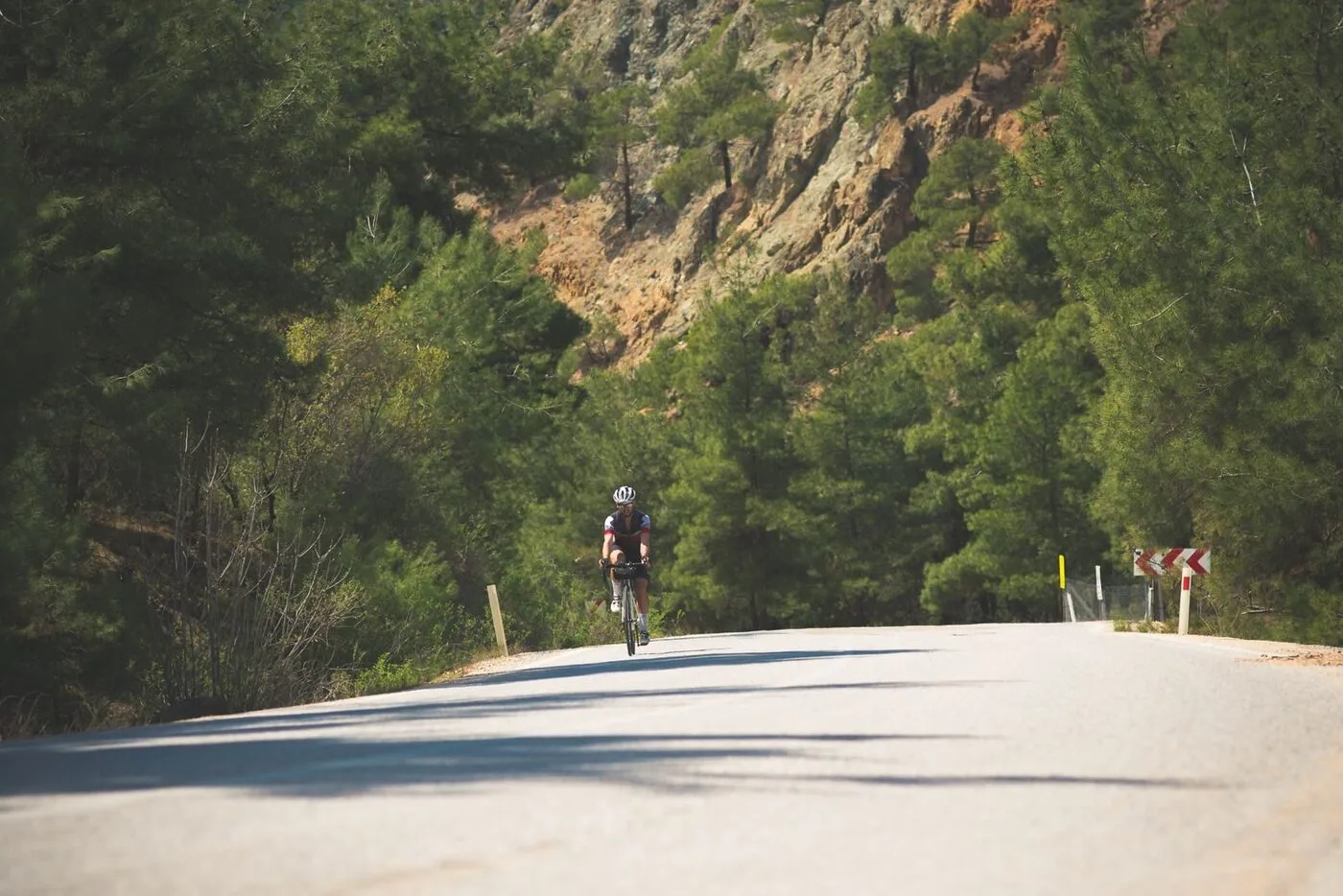
Cyprus has a reputation as a road-cycling destination, and it is mostly deserved. But the eastern tip of the island has real off-road riding, and it is close enough to the resorts to be a morning rather than an expedition. If you are here for a week and want one day that is not tarmac, this is where it is.
Cape Greco
The headland between Ayia Napa and Protaras is a national forest park (385 hectares of it), and the tracks across it are the best-known off-road riding in the region. There is also about four kilometres of purpose-built bicycle track inside the park, which is worth knowing if you would rather not guess at what is and is not a legitimate line.
Set expectations correctly: this is coastal terrain (rock, low scrub, sea cliffs and sea caves) rather than forest singletrack. Expect exposure, hard surfaces and long views rather than loam, berms and tree cover.
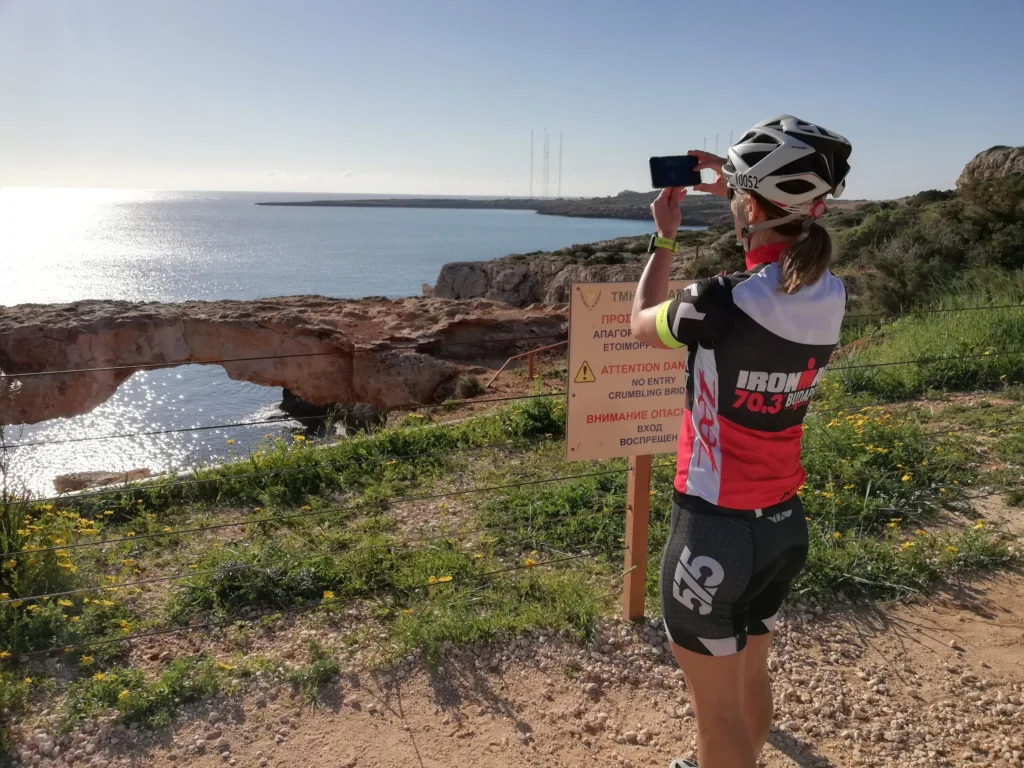
It is not technically extreme, which makes it a good introduction for a rider who is competent on a road bike and curious about going off it. The challenge is more about surface and heat than about difficulty. Loose rock over hardpack rewards a light touch on the front brake and looking further ahead than feels natural.
There is very little shade anywhere on the headland, and no water. That is the single most important planning fact about riding here, and it matters more than any line choice.
The tracks behind Achna Dam
Inland, the agricultural tracks around the Achna reservoir give a quite different ride: flatter, longer, and easy to link into a bigger loop through the red-soil villages. This is where to go if you want distance off-road rather than terrain, or if the wind on the coast has made the headland unappealing.
It is also the better option for a gravel bike, or for a rider who wants to mix surfaces in one ride rather than committing to a full off-road day. The reservoir itself is a wildlife reserve and a pleasant place to stop.
What bike you actually need
A hardtail is the right tool for nearly all of this. The surfaces here are hard and rocky rather than soft and technical, so the suspension travel that matters in an alpine bike park is largely wasted, while the pedalling efficiency of a hardtail is worth a great deal on the long flat links between the interesting sections.
A few things that make more difference than suspension travel:
- Tyre choice over tyre size. Sharp rock punishes thin sidewalls far more than it punishes narrow tyres. Something with a reinforced casing is worth more here than an extra few millimetres of width.
- Pressure. Running very low pressure for grip on hardpack and rock mostly buys you pinch flats and rim damage. There is less grip to gain than on soft ground.
- Bottle capacity. Two cages, or a pack. This is the terrain where running out actually happens.
- A spare tube even if tubeless. A sidewall cut on sharp limestone is the classic way a good morning ends early.
That is what we stock for it: our mountain bike rental is hardtail-based and sized for adults across the usual range, and if you are staying at that end of the coast it is delivered: bike rental in Ayia Napa. If your week is mostly tarmac with one off-road day in it, it is worth reading our road bike rental pages too and deciding which way round to book. For many visitors the right answer is a road bike for the week and the mountain bike as a separate booking.
Kit for off-road in heat
Off-road riding in this climate is harder on the body than the same duration on tarmac, because the average speed is lower and so is the airflow. A ride that would be comfortable at twenty-five kilometres an hour on the coast road is a different thing at twelve on a track with no shade.
Plan for roughly the same water as a road ride half again as long, take a phone with charge in it, and tell someone the rough plan. Phone coverage is generally fine, but the terrain is open, hot and not somewhere to be stuck with a mechanical in the middle of the day.
Riding it responsibly
- Cape Greco is a protected park and a walking destination as much as a riding one. Expect pedestrians on every track, and give way to them.
- Stay on established tracks. The scrub recovers slowly and the erosion from cut lines shows for years.
- Start early in summer. There is no shade and no water on the headland.
- Take your rubbish out, including punctured tubes and gel wrappers.
Do I need full suspension?
No. For this terrain a hardtail is the more appropriate bike. Full suspension earns its weight on sustained rough descents and technical singletrack, and there is comparatively little of either here. You will spend more of the day pedalling across open ground than you will descending.
Can I ride it on a gravel bike?
The Achna tracks, yes, comfortably: that is close to ideal gravel terrain. Cape Greco is more marginal: some of it goes fine on a gravel bike with wide, tough tyres, and some of it is rocky enough to be unpleasant. If you only have one day off-road and are on a gravel bike, the inland tracks are the safer choice.
Is it beginner-friendly?
For someone who rides bikes but has not ridden off-road, yes, with the caveat that the heat and the exposure are the real difficulty rather than the terrain. Go early, go with someone, and turn back sooner than you think you need to. If you are unsure whether it suits your level, get in touch. It is a short conversation and it saves a wasted morning.