
Looking for a personal trainer in this part of Cyprus is oddly difficult, and not because there are none. It is because almost none of them are findable: the search results are forum threads a decade old, directory sites that scraped a phone number once, and gym pages that list classes rather than people. Most of it happens by word of mouth, which works well if you already know somebody and not at all if you have just moved here or arrived for the winter.
So this is the article we would want to read: what a session actually is, what to ask before you commit to anything, and the honest version of where it should happen.
What a session actually involves
One person, one coach, a defined block of time, and a plan that was written for you rather than for a class. That is the whole of it, and the value is concentrated in two places that are easy to miss when you are comparing prices.
The first is that somebody is watching. Most training injuries and most plateaus are technique problems, and you cannot see your own technique. This is the part that does not transfer to an app or a video.
The second is that somebody adjusts it. A plan survives contact with a bad week, an illness, a work trip or a sore knee only if there is someone to change it. A written programme that nobody revises is a document, not coaching.
Sessions here run early in the morning, before the shop opens, and they are booked as slots on a real calendar rather than arranged by phone afterwards: see 1-to-1 sessions for what is actually available and when. That timing is not an eccentricity: training on this coast happens at first light for most of the year, and training through the heat explains why in more detail than anyone wants.
What to ask before you book anybody
These are the questions that separate a trainer from somebody who counts your reps, and they apply to us as much as to anyone else.
- What happens in the first session? If the answer is a workout, be careful. The first session should mostly be an assessment: what you can do now, what hurts, what you actually want.
- What do you do if I do not enjoy this? Adherence is the whole game. A trainer with no answer to that is planning for a version of you that does not exist.
- What happens between sessions? Two hours a week is not what changes anything. The other hundred and sixty-six are the programme.
- How will we know it is working? If the only answer is the bathroom scale, look elsewhere: see losing weight without joining a gym for why that single number is such a poor instrument.
- What do you not do? Anybody who claims every specialism has none. Nutrition, rehabilitation and sports medicine are different jobs, and a good coach will say where their edge is.
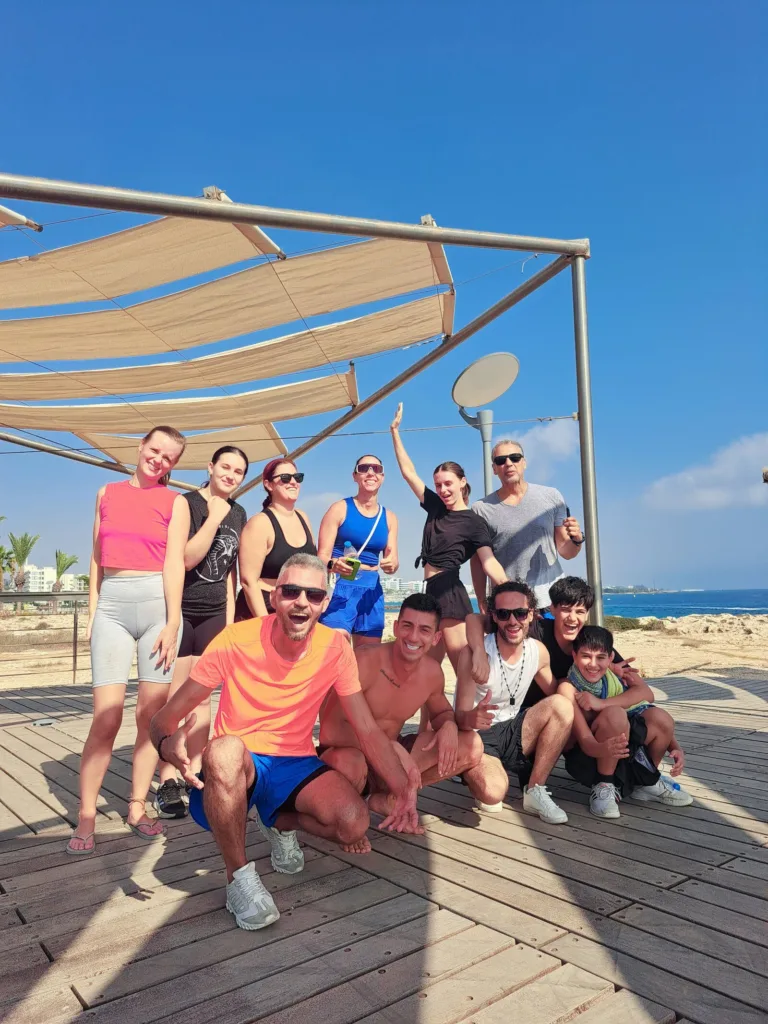
It does not have to be in a gym
This is where we differ from most of what you will find locally, and it is worth being straight about it rather than dressing it up as science.
Gym training is part of the system here. It is not the identity. Plenty of people who want to get fitter have already decided they are not going to become gym people, and treating that as a character flaw to be overcome is how trainers lose clients in week three. The seafront, the coast path and the sea are all available, they are free, and for a lot of people they are the difference between training and intending to.
The honest caveat: the research on outdoor versus indoor training is weaker than the headlines suggest, and at least one systematic review says plainly that the evidence for an added physical benefit is limited. So we are not claiming outdoor training builds more strength. We are claiming that the training you will actually turn up for is the one that works, and for a large number of people here that one is outside. Training outdoors on the Cape Greco coast is what it looks like in practice.
Who this suits
- People who have never trained at all, and for whom walking into a gym is the actual obstacle rather than the exercise.
- People coming back after a long gap: after an injury, an illness, a pregnancy, or a decade. This group most needs somebody watching, and most often trains alone.
- People with a specific goal and a deadline: a wedding, a first race, a hike they have promised themselves. Deadlines make coaching efficient.
- Athletes in another sport who need strength work that supports it rather than competes with it. Riders and swimmers, mostly.
- Visitors staying long enough for it to mean something. A fortnight of consistent early sessions is a real training block, not a novelty.
Where to start
Personal training covers the 1-to-1 work: gym, outdoor, bodyweight, and the coming-back-from-nothing case, which is the most common one. If you would rather talk it through before booking anything, the consultation is an hour and it can be done on the phone rather than in person, which is the sensible option if you are not on the island yet.
If what you want is not really personal training but structure you can follow on your own, what coaching at a distance can and cannot do sets out what survives being delivered remotely and what does not.
Do I need to be fit before I start?
No, and the question is worth retiring. Getting fit before hiring somebody to help you get fit is the fitness equivalent of tidying up before the cleaner arrives. Starting from nothing is the ordinary case, not the awkward one.
Is it in a gym or outdoors?
Either, and it is a decision made with you rather than a house style you have to accept. Some goals do want a loaded barbell and a controlled environment; plenty do not. What matters more than the venue is that you keep turning up to it.
How often should I train?
Twice a week with a coach and something on your own in between is the pattern that works for most people who are not training for a specific event. Once a week works if the between-sessions plan is real. Five times a week from a standing start is how people get injured in month two.
I only want to lose weight. Is a trainer the right thing?
Partly, and it is worth being honest about the proportions: most of weight loss is what you eat, and no amount of training out-runs that. Where a trainer earns their place is in keeping the muscle you have while the weight comes off, and in building a habit that survives the end of the diet. Our guide to losing weight without joining a gym is the longer answer.