
There is a triathlon at Nissi Beach in Ayia Napa, run by Nireas (the oldest triathlon organisation on the island), with a middle-distance, an Olympic and a sprint race plus a standalone swim. It is about fifteen minutes from our door.
That is unusually convenient for anyone who wants to train on the actual terrain, and it is the reason this article exists. We are not going to print a date here, because race dates move and a page with a stale date on it is worse than no page. Check the Nireas site for the current edition.
What follows is about the training rather than the entry form.
What the location asks of you
Three things about racing on this coast that are different from racing at home, and all three are trainable.
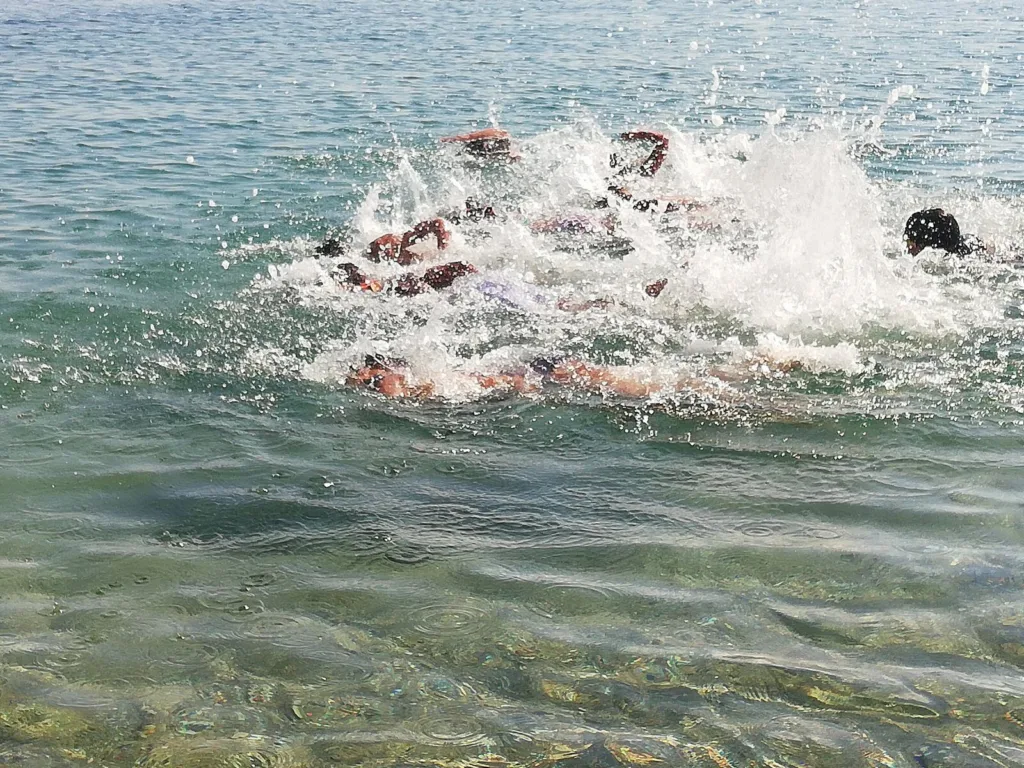
Open water, and the sea rather than a lake. Sea swimming has chop, salt and sighting problems that a pool does not, and the difference between a competent pool swimmer and a competent open-water swimmer is larger than most people expect. It is the single most common reason a first triathlon here goes badly.
Heat, on the run more than the bike. Even in the cooler months, by the time you are running you have been out for a while and there is not much shade on this coast. Pace and hydration decisions made on the bike show up on the run.
Wind, on the bike. This is a coastal course in a place where the wind off the sea is the main determinant of how hard a flat ride feels. A power or effort target you set at home on a still day is not the right target here.
Training here for it
The advantage of being on this coast is that every discipline is available on the same morning without driving anywhere.
- Swim. Open water on the actual coastline, in the actual sea, rather than a lake that behaves nothing like it. Sighting practice against real landmarks is worth a great deal on race day.
- Bike. The coastal roads for flat, wind-exposed efforts; the inland village roads when the wind makes the coast pointless. Both within a few kilometres of each other, which is a luxury for structured sessions.
- Run. Seafront and boardwalk for pace work, and the same heat and light you will race in.
- Brick sessions. Bike-to-run off the same stretch of coast, which is the session that most reliably predicts how the race actually goes.
The last six weeks
Assuming a base is already there, the specific work that matters close to a race like this:
- Get in the sea regularly. Not once. The adaptation to chop, salt and sighting is real and it takes repetition, and it is the thing most people skip.
- Practise the transitions. Free time, and the only place in the sport where the gain is guaranteed. Wetsuit off, shoes on, done in the order you have rehearsed.
- Rehearse the nutrition on a training day in the same conditions. Race day is the wrong day to discover a gel does not sit well in heat.
- Do at least two brick sessions at race effort. The legs off the bike are a shock the first time and not the second.
- Acclimatise if you are flying in. Arriving from a cool climate and racing three days later is doing it on hard mode. A week is better.
- Taper properly. More races are lost in the last fortnight to panic training than to anything that happened in the twelve weeks before it.
If you are flying in for it
A few practicalities specific to racing away from home on this coast.
Come early enough to swim in the sea at least twice before the race, and to ride a stretch of the coast so the wind is not a surprise. If you would rather not fly a race bike out and rebuild it the day before, our bike rental in Cyprus delivers to Ayia Napa and Protaras. See whether to fly your own bike out for the honest version of that decision, including the case for bringing your own, which for a target race is a stronger case than usual.
And if you are bringing your own, have the brakes and gears checked when it comes out of the box rather than on race morning. Our workshop does that.
Coaching for it
Ramo coaches triathlon as well as cycling, races himself, and knows this coast because he trains on it. That combination is the useful part: a plan written by somebody who has swum in that bay and ridden into that wind is a different thing from a generic twelve-week template.
Our coaching covers swim, bike and run, in person on this coast or remotely, and can be built around a specific race date rather than around a generic block. If you want the volume in one concentrated stretch instead, that is what the training camps are for.
The other races on the island
Nireas run triathlons elsewhere in Cyprus as well as the Ayia Napa one, so a trip can be built around more than a single date. Beyond triathlon, the island has an established road and mountain-bike race calendar: a gran fondo in the west, a mountain-bike stage race in the Nicosia district in early spring, and a well-known summit challenge from the coast to Mount Olympus.
We have deliberately not printed dates for any of them. Cycling and triathlon calendars move, at least one of those events has been postponed at some point, and it is better to send you to the organisers than to have a page here quietly go out of date.
Is the Ayia Napa Triathlon good for a first triathlon?
The sprint distance is a reasonable first race, with the caveat that a sea swim is a bigger step for a first-timer than a lake or pool swim would be. If it is your first, get sea time in beforehand (several sessions, not one), and treat the swim as the discipline to prepare for rather than the one to get through.
Can I train for it while on holiday here?
Easily, and plenty of people build a week around exactly that. Everything is close together: sea, coast road, inland roads and seafront running are all within a few kilometres of each other in this corner of the island, which makes a structured week much simpler than it is in most holiday destinations.
Do I need a wetsuit?
That depends on the water temperature at the time of the race and on the rules for that edition, which the organiser publishes, so check with them rather than with us. What is worth saying is that if you are going to race in one, train in it, because a wetsuit changes your stroke and your breathing and the first swim in one is never the good one.