
The short answer is yes, with the same qualification that applies to riding anywhere: it depends much more on where and when you ride than on the country. The longer answer is worth reading before your first ride here rather than after it, because two or three of the specifics are different from what a European rider is used to.
Nothing below is meant to be alarming. Most of it is the sort of thing a local would tell you in the first five minutes and nobody writes down.
Cyprus drives on the left
This is the big one and it is the one that catches out riders from mainland Europe. Driving on the left is a legacy of British administration, and it applies to bicycles exactly as it applies to cars.
The straight roads are not the problem. Nobody forgets which side of the road they are on while riding along it. The problem is everything else: pulling out of a junction, entering a roundabout, and above all the instinct about which way to look first. That instinct is deeply wired and it does not politely wait until you have adjusted.
Two habits fix most of it. Make your first ride short, quiet and inland rather than long and coastal: the village roads behind Protaras have junctions empty enough that a moment of hesitation costs nothing. And for the first couple of days, look both ways deliberately and twice at every junction, in the knowledge that your reflex is wrong here.
The other place it bites is on a group ride when someone at the front makes a turn and everybody follows without checking. That is worth saying out loud before you set off.
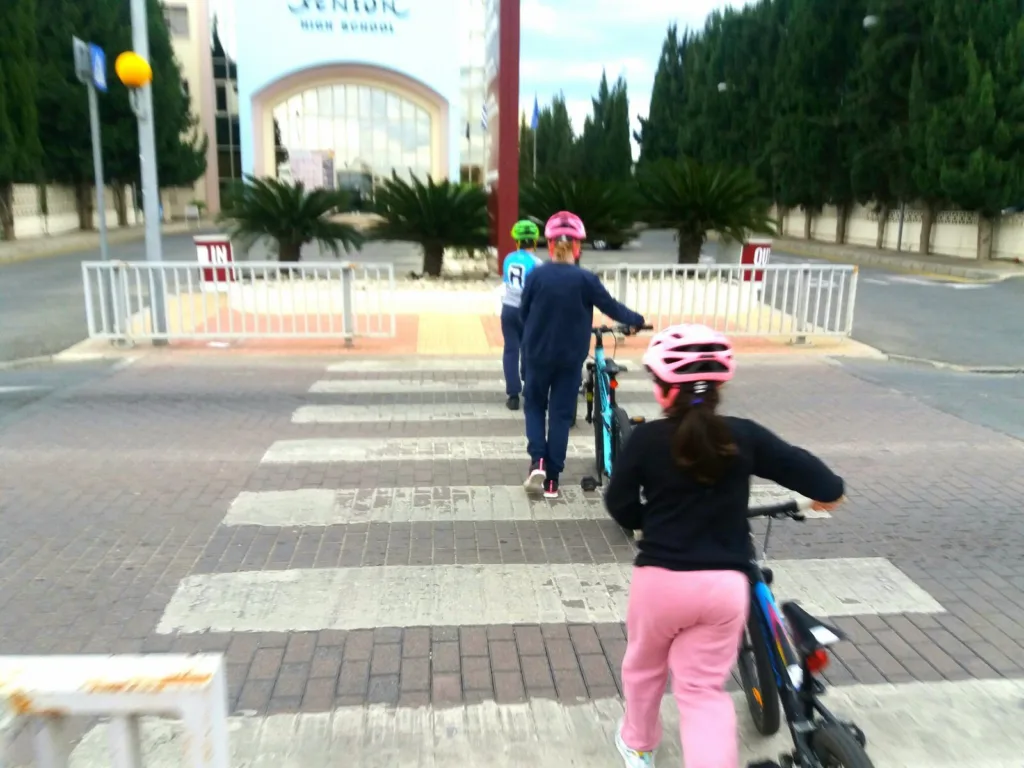
You may not cycle on the motorways
Cycling on the Cypriot motorways is illegal and carries a fine. This matters more than it sounds because the motorways are the fast, direct links between the main towns, so a navigation app set to the shortest route will happily send you onto one.
The practical rule is to check any route a phone gives you before following it, particularly for a longer point-to-point ride between towns. The parallel old roads almost always exist and are usually the better ride anyway.
What the roads are actually like
Surfaces on the main routes are generally good, better than a lot of visitors expect, and better than plenty of rural roads in northern Europe. The smaller agricultural roads inland vary much more, and that variation is the thing to plan around rather than the main roads.
Specific things worth knowing:
- Grit and washed gravel collect on bends and in dips on the smaller inland roads, especially after rain, and can sit there for days.
- Farm traffic inland, which is slow and wide rather than fast and dangerous, but does mean mud on the road in the growing season.
- Drainage channels and unmarked edges on some village roads. Worth not riding right at the edge of the tarmac.
- Cattle grids and rough patches on approaches to rural sites. Nothing exotic, but not a place to be looking at a computer.
Traffic, and when it is a problem
Driving standards in Cyprus are ordinary Mediterranean rather than exceptional in either direction. The problem for a visiting cyclist is volume and timing rather than aggression, and it is concentrated in two places.
The first is the resort coast road in season. Between Protaras and Ayia Napa, in high summer and from mid-morning, that road carries a lot of holiday traffic including a lot of people driving hired vehicles on a side of the road they are not used to either. It is a fine ride at 07:00 and a much less appealing one at 11:00.
The second is the main inter-town roads on weekend afternoons. Both problems have the same answer, which is the answer to nearly everything here: ride early.
Inland, the picture is completely different: the village roads behind the coast are quiet enough that traffic stops being a consideration at all. That contrast is one of the real advantages of the east coast, and it is covered in the routes around Protaras and Ayia Napa.
The heat is a bigger risk than the traffic
This is the part that gets underweighted. In summer, the thing most likely to turn a ride here into a real problem is starting at 10:00 with two bottles and no plan for refilling them, far more than any car.
Heat exhaustion arrives gradually and impairs judgement before it becomes obvious, which is exactly the wrong combination on a bike. The rule that works is unglamorous: out at first light, the substantial part of the ride done before mid-morning, off the bike through the middle of the day, and more water than the distance suggests.
It applies to the off-road terrain even more strongly, because the average speed is lower, the airflow is less, and there is no shade at all on the Cape Greco headland.
Sun, glare and being seen
Two lighting problems, both specific to here. In the morning on an east-facing coast the sun is low and directly behind you; in the late afternoon it is low and directly in the eyes of anyone driving west. On this coast a rear light in daylight is the single cheapest safety improvement available.
Glare off pale limestone and off the sea is also stronger than the air temperature suggests, which is a comfort point but also a spotting-a-pothole point. Decent sunglasses earn their place.
Riding with children
The inland village roads are suitable for a family ride; the coast road once the day is busy is not. That is not a subtle distinction, and it matters because the same area contains both. If you are unsure which roads suit a particular group, get in touch and ask, because it is a two-minute conversation and it is the sort of thing we know from riding it rather than from a map.
Practical precautions worth taking
- Ride early. It solves heat, traffic and glare at the same time, in every season.
- Run a rear light in daylight. Especially on the coast and especially in low sun.
- Carry a phone with charge in it, and tell somebody the rough plan if you are riding alone or going off-road.
- Check your travel insurance covers cycling. A surprising number of standard policies exclude it, and afterwards is the wrong time to find out.
- Carry water beyond what the distance suggests, and know where the refill points on your route are.
- Give yourself two easy days to adjust to the left before doing anything long or busy.
Is Cyprus safe for cyclists compared with the rest of Europe?
It is broadly comparable, with a different distribution of risk. There is less dedicated cycling infrastructure than in northern Europe, and there are far quieter rural roads than most of northern Europe has. The specific hazards that are worse here (driving on the left for a visitor, and summer heat) are both entirely manageable if you know about them in advance, which is the whole reason this page exists.
Do I have to wear a helmet in Cyprus?
Wear one. We are not going to try to summarise Cypriot road law here, because it changes and because getting it slightly wrong in writing would be worse than not saying it. Check the current rules if you want the legal position. As a practical matter every rider on our own tours wears a helmet, and hire helmets are available with any bike so there is no reason not to.
Is it safe to ride alone?
On the coastal and village routes, yes, and plenty of people do. Off-road on the Cape Greco headland is the one place worth being more careful about riding solo, because it is exposed, unshaded, and has no water. Tell someone the plan, take more water than you think, and go early.