
A surprising number of adults on this island cannot swim, and almost none of them say so out loud. People who live ten minutes from the sea, who take their children to the beach every summer, and who have spent thirty years standing in water that comes up to their chest.
If that is you, the useful thing to know is that it is a normal teaching problem with a normal answer, and that adults are not worse at it than children. They are different at it, which is not the same thing.
Why adults find it harder, and why that is fixable
Children learn to swim quickly mostly because they have not yet built a model of what could go wrong. Adults have. An adult in shoulder-deep water is doing arithmetic about depth and distance and what happens if their face goes under, and that arithmetic produces tension, and tension is what makes a body sink.
So the first sessions of teaching an adult are not really swimming lessons. They are about undoing the tension, and they look almost nothing like the lengths-up-and-down picture most people have in their head.
The second difference works in the adult’s favour and is rarely mentioned: an adult can be told why. A child is taught by imitation and repetition. An adult can be shown what their legs are doing and understand the correction, which means progress can be faster once the fear is out of the way.
What the first lessons actually involve
Roughly in this order, and nobody moves on until the previous one is comfortable rather than survivable:
- Being in water you can stand up in, without bracing. Sounds trivial. It is where most of the work is.
- Breathing out into the water. Not holding your breath: breathing out. This one change fixes more adult swimmers than any arm drill ever will.
- Floating, on the front and on the back. The discovery that the water holds you up is the moment the fear starts to go, and it is a discovery rather than a piece of information.
- Recovering to standing, deliberately, over and over. Knowing you can stop is what makes it possible to start.
- Moving: gliding first, then legs, then arms. Stroke comes last, which is the opposite of what people expect.
The order is the point. Adults who try to skip to the arms end up swimming a frantic, exhausting version of front crawl that is unpleasant enough that they stop.
Pool first, sea second
The pool is where you learn, and it is worth being clear about what it is for: technique, drills and skill development, in water that does not move, where you can be corrected and can repeat something twenty times without being blown sideways.
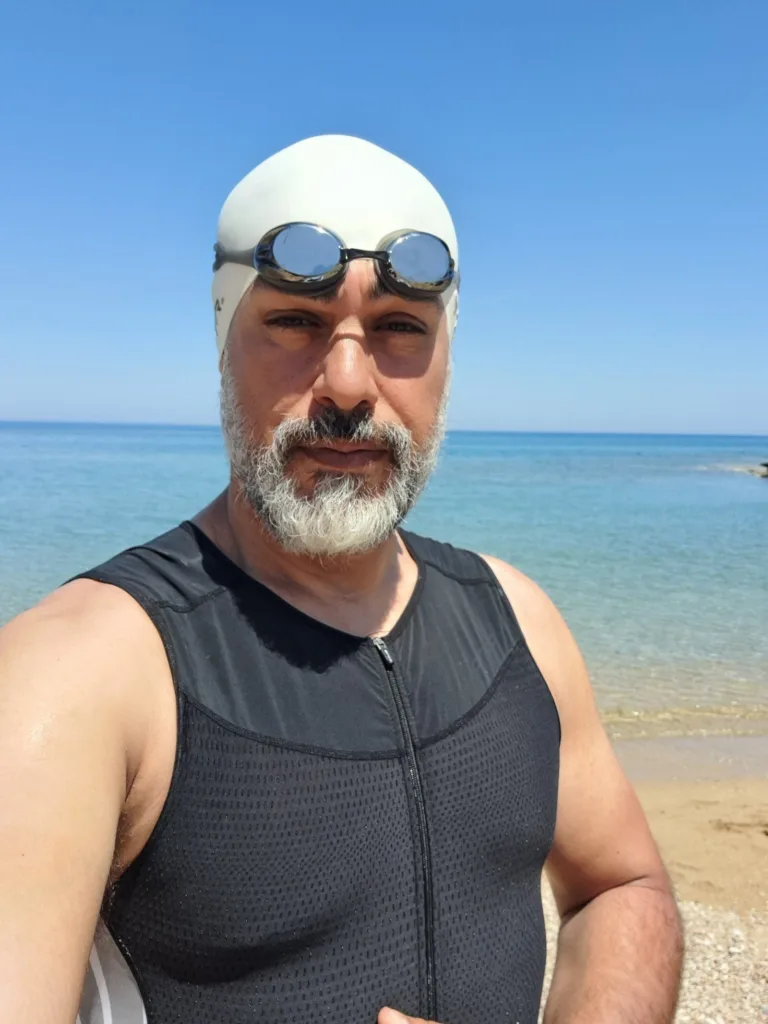
It is not the destination. Around here the point of learning to swim is the sea: going in with your family, getting to the rocks and back, and eventually swimming for the sake of it. So the sea arrives in the lessons as soon as it reasonably can, in shallow water, parallel to the shore, in the calm early part of the day. Swimming in the sea here covers what changes when you get there.
How long it takes
It depends on the fear more than on the fitness, and anybody quoting you a number of lessons before meeting you is guessing.
What is safe to say is the shape of it. Getting comfortable and able to move independently in shallow water is a small number of sessions for most adults. Swimming a recognisable, sustainable front crawl is a longer project measured in months of regular practice, and the people who get there are the ones who go twice a week rather than the ones who go hard once.
Frequency beats intensity by a wide margin here, because most of what you are building is comfort, and comfort decays between sessions.
Learning alongside your children
It comes up constantly, and it is usually worth separating. A parent working on their own fear while supervising a child is doing two difficult things at once and will do neither well, and children are quick to notice a nervous adult in the water.
Separate sessions, same morning, is the arrangement that tends to work. The youth side of the coaching here already includes swimming alongside the bike handling. See youth cycling, and getting a child riding covers the parent’s half of that in more detail.
Where to start
Swimming coaching here covers adults from a standing start as well as swimmers who want to be faster, and the two are different jobs rather than the same lesson at different speeds. If you would rather have a conversation before committing to anything, the consultation is an hour, and it can be on the phone.
Am I too old to learn to swim?
No. That is not encouragement but the ordinary experience of anyone who teaches adults. What changes with age is not the ability to learn but the amount of accumulated caution to work through, and that is what the first sessions are for.
Do I need to be fit to start?
No. Swimming badly is exhausting and swimming well is not, so fitness is largely a consequence of the technique rather than a prerequisite for it. The early sessions are short and low-effort by design.
I put my face in the water and panic. Is that normal?
Yes, and it is usually a breathing problem wearing a fear costume. Most adults who panic with their face in are holding their breath, which builds carbon dioxide, which produces exactly the urgent need-to-surface feeling they are afraid of. Breathing out steadily into the water removes most of it, and it is the first thing a good teacher will work on.
Can I learn in the sea instead of a pool?
Eventually, and it is the goal. Not at the start. The sea moves, it is deeper than it looks, and it cannot be stopped while you work something out. All of those are fine once you can swim, and all of them make learning harder than it needs to be.