
Most people who swim in Cyprus swim in a hotel pool twenty metres from a sea they never get into. That is a strange way round, and it is the reason this article exists: the sea on this coast is one of the better places in Europe to learn open water, and almost nothing written about it is aimed at somebody who wants to swim rather than sunbathe.
What follows is about the water and about the skills, not a list of beaches with car parking notes. Where a fact here is specific, it is somebody else’s fact and it is attributed, because the reliable-looking numbers in this area are mostly modelled satellite data that disagree with each other by two degrees.
What the water actually does through the year
The Deputy Ministry of Tourism publishes the honest version, and it is worth having in front of you before you plan a swimming trip. Its wording: the temperature in the open sea hovers above 22°C from June to November, climbing to 27°C in August, and even during the three coolest months of January to March the average sea temperature is an acceptable 16 or 17°C.
Two things follow from that, and they are the two things people get wrong in opposite directions.
The season is longer than a northern European expects. Six months above 22°C is a long open-water season by any standard, and October is still comfortably in it, which is why the autumn here is the best time of year to be in the water.
And it is shorter than the brochures claim. You will find sites confidently telling you the swimming season runs May to December and the water never drops below 20°C. It does. January to March is 16 or 17°C, which is swimmable in a wetsuit and a real decision without one, and pretending otherwise is how somebody ends up cold and frightened a long way from the beach.
You will also find monthly sea temperatures quoted to one decimal place. Ignore them. They come from modelling rather than measurement, and the three most-cited sources contradict each other by more than a degree in the same month.
Where people swim on this coast
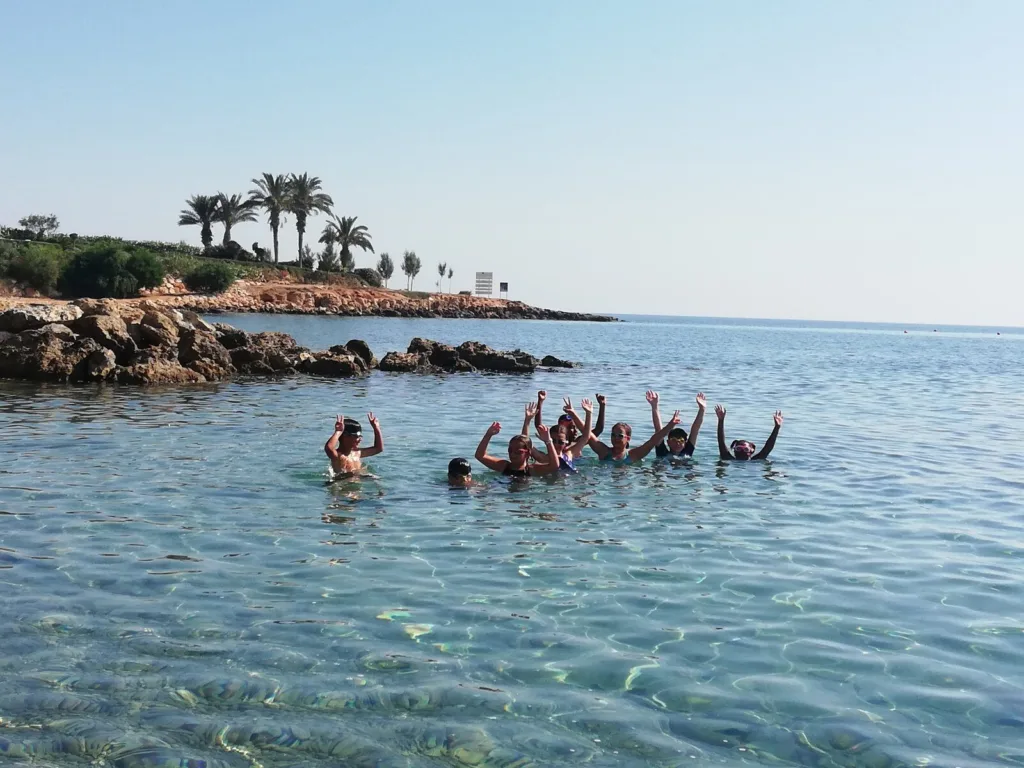
The eastern corner has an unusual concentration of sheltered, shallow-entry bays within a few kilometres of each other, which is the single practical reason it works for open water. When one side is being blown out you drive ten minutes and swim on the other.
Fig Tree Bay, Protaras. The best-known bay on this coast and a Blue Flag beach. It is also a race venue: it hosted a leg of the European Aquatics open-water calendar, which is not something most resort bays can say.
The bays around Cape Greco. Cape Greco is a national forest park on the headland between Protaras and Ayia Napa, and the small bays either side of it are clearer and quieter than the resort beaches. They are also more exposed, so they are a wind decision rather than a default.
The Ayia Napa beaches. Long, shallow and busy in season, which makes them good for a first sea swim and poor for a long one in August, for the same reason.
We are deliberately not printing entry points, depths, currents or boat lanes for any of them. Those change with the season and the weather, they are the details that actually matter to your safety, and a page that got one of them wrong once would be worse than no page at all. Ask somebody who swam that bay this week.
The wind decides, not the forecast temperature
The mistake visiting swimmers make is planning around air temperature. On this coast the variable that decides whether a swim is pleasant or miserable is the wind, because it decides the chop, and chop is what turns a comfortable thirty minutes into a fight.
A bay that is glass at seven in the morning can be unswimmable by eleven. That happens on any coast. It is more pronounced somewhere the mornings are so reliably still. The habit worth forming is the same one riders form here: go early. It is the same logic that governs training through the heat, and for the same reason.
What open water asks that a pool does not
The gap between a competent pool swimmer and a competent open-water swimmer is wider than almost anyone expects, and it is not a fitness gap. Five things change at once:
- There is no line on the floor. You have to sight, which means lifting your eyes every few strokes without wrecking your body position. It is a skill, it looks easy, and untrained swimmers add a surprising amount of distance to every swim by not having it.
- There is no wall. No push-off, no rest every twenty-five metres, and no natural place to stop and think. Continuous swimming is a different rhythm and it has to be built.
- The water moves. Chop interrupts your breathing timing, which is the thing most likely to tip a nervous swimmer into panic.
- Salt. More buoyant, which flatters your body position, and harder on the throat over an hour than people expect.
- You cannot see the bottom, or you can and it is a long way down. This is the one nobody admits to. It is extremely common and it responds to graded exposure rather than to willpower.
Which is why the pool still matters, and why it is a tool rather than the destination. Technique, drills and skill development are what a pool is good for: you can be corrected, you can repeat something twenty times, and nobody is being blown sideways. Then you take it outside, where the actual swimming happens.
Starting safely, which is most of it
- Never alone. Not as a rule for beginners. As a rule for everyone. Swim with somebody, or swim where somebody is watching.
- Be visible. A bright cap and a tow float, every time. A swimmer in the water is close to invisible to anything with an engine.
- Swim parallel to the shore, not out from it. Same distance, and every point of it is a short swim from dry land.
- Know your exit before you start. Pick the landmark you are coming back to, from the water, before you are tired.
- Get in slowly in the cool months. The gasp when cold water hits your chest is a reflex, not fear, and it is manageable if you are expecting it and standing in waist-deep water when it happens.
- Turn round earlier than you want to. The way out always feels easier than the way back, in exactly the way a headwind does on a bike.
Getting coached in it
Ramo offers swimming coaching in both places: the pool for technique and drills, the sea for the thing itself. Open water is the local part of the offer: sea sessions on this coastline, with somebody who swims it year-round rather than somebody applying a pool programme to a bay.
If you have never swum properly at all, start with learning to swim as an adult rather than here. The order matters and it is not the order most people try. If you are swimming already and want it to lead somewhere, the races on this coast include an open-water event, and triathlon coaching treats the swim as the leg most worth fixing.
Can I swim in the sea here all year?
Yes, with the caveat that January to March is a wetsuit for most people rather than a preference. The official range for those three months is 16 to 17°C, which is a cold-water swim: short, deliberate, and not somewhere to discover that you do not like cold water.
Do I need a wetsuit?
From roughly June to November, no. Outside that, most people want one. Worth knowing either way: a wetsuit changes your body position and your stroke and restricts your shoulders, so the first swim in one is never the good one. If you plan to race in a wetsuit, train in it.
Is open water safe?
It is as safe as the habits you bring to it, and that is a real answer rather than a hedge. Almost everything that goes wrong in open water traces back to one of four things: swimming alone, being invisible, going too far out rather than along, or being colder than you admitted. All four are decisions made on the beach, not emergencies that arrive in the water.
I can swim, but I panic when I cannot see the bottom
That is so common that it is close to universal, and it is not a character flaw or a fitness problem. It responds to graded exposure: shallow water first, parallel to the shore, with somebody beside you, in increments small enough that you never actually get frightened. What does not work is deciding to be braver on the day.