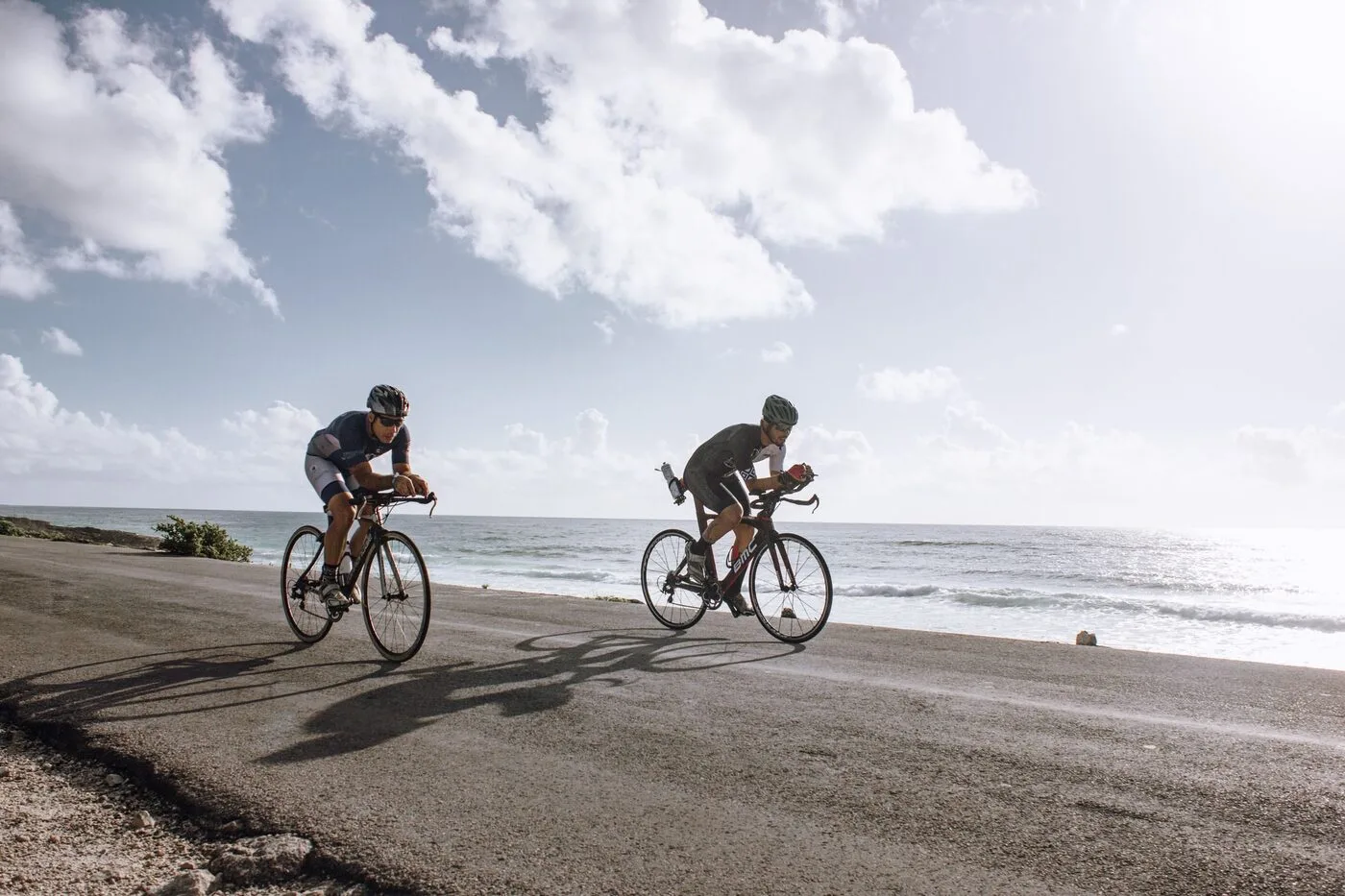
Cyprus works as a cycling destination for one straightforward reason: it is rideable in the months when most of Europe is not. While northern riders are on indoor trainers, the coast here is in short sleeves. That is why the island fills with training camps between January and April, and why a good number of visitors discover the riding by accident, on a family holiday, and come back the next year specifically for it.
This guide covers what each season actually feels like on a bike, how the two very different halves of the island ride, and the practical things that catch visiting cyclists out. It is not a route list. For that, see our guide to the routes around Protaras and Ayia Napa.
Winter: the reason people fly here
Winter is the island’s strongest cycling season, and it is the opposite of what northern Europeans expect from December to February. Coastal daytime temperatures are mild, the light is long and low, and the roads are quiet because the summer tourist traffic has gone home. For a rider whose home roads are dark, salted and four degrees, that combination is worth a flight on its own.
It is not uniformly warm, though, and this is where people get their packing wrong. Mornings start cold enough for long sleeves, and a ride that begins at 08:00 is a different proposition from one that begins at 11:00. Rain arrives in short, heavy spells rather than as all-day drizzle, so a packable jacket is more useful than a heavy waterproof.
The mountains behave like a separate country. There is snow on the high Troodos most winters (there is a ski area up there), so a plan that involves both coastal riding and a mountain day needs checking against two different forecasts. More on that below.
Winter is also when structured training happens here. If you are building a base for a spring target, the combination of consistent weather and terrain that offers both flat and mountainous options in one small island is hard to find elsewhere in Europe at that time of year. We have written about cycling here in winter at more length, because it is the season most visitors get wrong in both directions: some expecting summer, some expecting a northern winter.

Spring: the best all-round window
March through May is when the island is at its best on a bike, and if you are only coming once this is the window to pick. Temperatures suit long days in the saddle without the heat management that summer demands. The countryside is green rather than burnt. The mountains have opened up properly, so a big climbing day is available without a winter kit list.
It is also the busiest cycling season, which cuts both ways: more riders on the road and more demand for hire bikes, but also more chance of finding a group to ride with.
Late spring is the point at which the heat starts to become a factor rather than a non-issue. By May, the habit of starting early is worth adopting even if you could get away without it.
Summer: ride early, or do not ride
July and August are hot, and inland is hotter than the coast. Riding is entirely possible (people do it all summer), but the day has to be restructured around the heat rather than the heat worked around the day.
The pattern that works is simple and non-negotiable: out at first light, the substantial part of the ride done before mid-morning, and off the bike through the middle of the day. Riders who try to keep northern-European habits here, setting off at 10:00 for a four-hour ride, have a bad time and sometimes a dangerous one.
A few things matter more in these months than any route choice:
- Water volume. Two bottles is a minimum rather than a comfortable margin, and you should be planning refill stops into the route rather than hoping to find them.
- Electrolytes, not just water. Drinking plain water while sweating heavily for three hours is its own problem.
- Sunscreen, reapplied. A single morning application does not survive a sweaty ride, and the reflected light off pale rock and sea adds to what you get directly.
- Light kit. Light-coloured, well-ventilated, and a cap or similar under the helmet.
- Honest pacing. The effort that feels moderate at twenty degrees is not moderate at thirty-five. Heart rate drifts upward for the same power, and the correct response is to slow down.
Acclimatisation is real and takes the better part of a week. If you arrive from a cool climate and immediately attempt your normal training load, the first few days will feel disproportionately hard. That is not a fitness problem and it passes.
Autumn: the quiet second spring
From late September the heat breaks and the riding becomes excellent again, with the added advantage that the island is emptier than in spring. Sea temperatures are still high well into October, which is a real consideration if you are combining riding with a family holiday: the non-cyclists in the group get a proper beach trip while you get your miles in.
Autumn is underrated here and worth considering if spring dates are hard to get.
The two Cypruses: coast and mountain
The single most useful thing to understand before booking is that this island offers two quite different kinds of riding, and they are far enough apart that you choose between them on any given day.
The eastern corner (Protaras, Ayia Napa, Paralimni and the red-soil farming villages inland) is gentle and rolling. Distances between villages are short, the gradients are modest, and it is well suited to easy days, mixed-ability groups, and riders who are not in peak condition. It is also the friendliest place to get used to riding on the left.
The Troodos range in the centre of the island is a different sport. Mount Olympus stands at 1,952 metres and the climbs are long and sustained rather than short and steep, closer in character to an Alpine pass than to anything rolling. It is the reason serious riders choose Cyprus over a flatter Mediterranean island.
That split is useful when planning a week. You can put one mountain day in the middle and ride flat, social routes either side of it, without changing hotel. What you cannot do is ride from the east coast to the mountains and back in a day and still have a good time. The transit eats the day. The usual answer is to drive out and ride there, which is covered in our guide to climbing in the Troodos.
Which end of the island to stay at is the question underneath all of this, and it has a less obvious answer than most guides give. We have set out the case both ways in where to base yourself.
What the roads are actually like
Two things surprise visiting riders more than the weather does.
Traffic drives on the left. This catches out riders from mainland Europe far more than they expect. The problem is rarely the straight roads; it is junctions, roundabouts, and the instinct about which way to look when pulling out. It is worth making your first ride a short, quiet one rather than a long day that starts on a busy coast road, and worth being deliberate about it for the first couple of days rather than trusting habit.
The wind is a bigger factor than the hills, on the coast. An outbound leg that felt easy can be a completely different ride coming home. Plan loops with that in mind, and if you are riding out-and-back, consider taking the headwind first.
Road surfaces on the main routes are generally good. Smaller agricultural roads inland vary more, and after rain there can be mud and grit washed across them, which is worth remembering on a bike with 25mm tyres and rim brakes.
How long to come for
A week is the natural unit and enough to get a proper block of riding in. A structure that works well:
- Day one: short, easy, flat. Get used to the bike, the heat and riding on the left.
- Days two and three: build up on the eastern routes: villages, the dam, the coast.
- Middle of the week: the mountain day. It is the one that needs you fresh.
- Day after: easy recovery spin, or off the bike entirely.
- Final days: the longer coastal rides, and whatever you enjoyed most.
Ten days to a fortnight allows two mountain days and a genuine training block, which is what most organised camps are built around.
Getting a bike
Bringing your own bike is an option, and for some riders (anyone with an unusual fit, or a specific race bike) it is the right one. But for a trip of a week or two, the arithmetic usually favours hiring. Airline bike charges apply in both directions, transit damage is a real risk, boxing and rebuilding costs time at both ends, and moving a bike bag between airport, hotel and back is a chore. We have gone through whether to fly your own bike out properly, including the cases where flying it out is clearly the right call.
We offer bike rental in Cyprus with delivery to Protaras, Ayia Napa and Larnaca, so the bike can be waiting when you arrive rather than being something to collect on your first morning. Helmets, pedals and computers are available as extras, which means you can travel with shoes and a jersey and nothing more.
If you would rather not plan routes at all, our guided cycling tours cover the eastern villages, the coast and a full day in the mountains, with a guide who rides these roads year-round. And if you have brought your own bike and it has not travelled well, our workshop can put it right.
Is Cyprus good for beginners?
The eastern corner is. Short distances between villages, modest gradients, frequent cafes and a small enough area that you are never committed to a long ride home. The mountains are not beginner terrain, but nothing forces you to go there.
The one thing to take seriously as a newer rider is the heat, because it makes an easy ride hard faster than a hill does. Start early, carry more water than you think, and cut the ride short without embarrassment if it stops being fun.
Road bike or mountain bike?
For most visitors, a road bike. The riding that makes Cyprus worth the flight (the coastal routes and the mountain climbs) is tarmac, and the road network reaches everywhere you would want to go.
A mountain bike makes sense if you specifically want the Cape Greco trails or the agricultural tracks inland, and it is a good choice for a rider who wants to explore rather than to train. If you are unsure, our road bike rental and mountain bike rental pages describe what each is suited to here.
Do I need to be fit to enjoy it?
For the eastern routes, no more than you would need for a comfortable weekend ride at home. For a Troodos day, yes: the climbing is sustained and the descents are long enough to be tiring in their own right. It is entirely reasonable to spend a week riding the coast and never go near the mountains, and plenty of people do.